Knife Hit Master: Arcade Game
- 4.7
- Rating
- 10.00K
- Installs
- Free
- Price
 Analysis by App-foxy
I spent time with Knife Hit Master as the kind of quick arcade game you open when you want an immediate challenge rather than a long session. Its basic idea is easy to understand: tap to send knives toward targets, avoid awkward collisions, and keep moving through short levels. That simplicity is its biggest attraction. I did not need a tutorial-heavy introduction or a complicated control scheme before getting started.
Created by Playoff Games Co., this free arcade game is aimed at a broad audience and carries an Everyone age rating. It is currently listed as version 0.5.1 and requires Android 9 or later. Those details matter because the game’s appeal depends on being easy to pick up, especially when I have only a spare minute or two. It is not trying to replace a deep action game; it is a compact reflex test built around timing and repetition.
How the speed feels during ordinary play
The first thing I noticed is that the game’s perceived speed comes less from complex movement and more from how quickly each decision arrives. A tap produces an immediate action, so there is very little distance between thinking and trying. That makes the opening moments approachable, while later attempts naturally feel more demanding as I try to place each knife with less hesitation.
You May Also Like

 AccuWeather: Weather Radar
AccuWeather Review: A Quick, Clear Forecast for Everyday Decisions
For everyday plans, the best forecast is the one you can understand quickly. AccuWeather makes rain timing, radar, and local conditions easy to act on, with a few trade-offs.

 Hill Climb Racing
Why Hill Climb Racing Still Turns Crashes Into One More Run
A tiny car, a bumpy hill and one more upgrade: Hill Climb Racing keeps resurfacing because its simple chaos makes every near-miss feel personal.

 AliExpress - Shopping App
AliExpress Makes Global Shopping Feel Personal, but Shoppers Bear the Risk
AliExpress turns a global marketplace into a pocket-sized discovery engine. Its reach is useful, its shopping loop compelling, and its trade-offs easy to miss.

 Lords Mobile: Kingdom Wars
Lords Mobile Is a Kingdom-Building Routine, Not a Quick Match
A case-by-case verdict on the building, battles, device demands, and social commitments that make Lords Mobile rewarding for some players and exhausting for others.

 PDF Scanner app - TapScanner
TapScanner Makes Paperwork Easier to Capture, Check, and Share
TapScanner makes scanning with a phone feel less like a rescue operation and more like a dependable step in getting work done. Its capture tools are useful, though not flawless.

 Block Blast!
 Shows How Much a Puzzle Game Can Leave Out
A quiet grid game shows why puzzle players increasingly value instant clarity, repeatable skill and low-pressure play—and where the genre still needs to catch up.
More From Our News Desk
View All News


This is a useful design choice for a mobile arcade title. I can play while waiting for transport, during a short break, or between larger tasks without having to remember a story or rebuild a complicated strategy. A failed attempt also feels easy to restart mentally: I know what went wrong, and the next round gives me a chance to adjust my timing rather than asking me to repeat a long setup.
The game is best understood as a concentration loop. I watch the target, wait for a safe opening, tap, and immediately prepare for the next placement. That rhythm can feel brisk even when the controls themselves are simple. The challenge is not learning a large move set; it is staying calm when the available space becomes less forgiving.
The real test is controlled timing, not frantic tapping. Treating every moment as a race can make an attempt worse, because an extra tap at the wrong time is more damaging than a short pause. I found that the most useful habit is to look at the target before acting, then commit to one deliberate input. That approach makes the game feel more consistent and gives each failure a practical lesson.
Why short sessions work so well
Knife Hit Master fits the familiar “one more try” pattern. A session does not need a fixed appointment, and I can stop after a single attempt without feeling that I have abandoned a large campaign. That makes it a better match for casual players than arcade games that require long runs before progress feels meaningful.
It also suits people who enjoy improving a small personal routine. Instead of memorizing elaborate combinations, I can focus on reading the target, choosing a safer moment, and avoiding rushed inputs. This gives the game a modest skill ceiling that is easy to approach but still capable of holding attention for players who like repeating a task until their timing becomes cleaner.
There is a trade-off here. If I want a strong sense of exploration, character development, or a changing world, this is not the right kind of game. Its satisfaction comes from the immediate action and the attempt to perform better, not from discovering a large amount of content. Players who prefer narrative arcade adventures or puzzle games with extended planning may find the loop too narrow.
What happens when I play repeatedly
Heavy use in this case means repeated attempts rather than a complicated multiplayer session or a large content load. The demanding part is maintaining attention across several rounds. The longer I keep trying, the more tempting it becomes to tap on instinct. That is where a small reset helps: I pause briefly, look at the next target, and begin again with a clear rhythm.
This makes the game surprisingly useful as a short focus exercise. I would not describe it as a productivity tool, but it can occupy the hands without requiring constant reading or audio. For example, if I am waiting for a friend who is running late, I can play a few attempts, stop when the message arrives, and return later without needing to reconstruct a complicated objective.
During a longer play period, the main friction is repetition. The same core interaction remains central, so enjoyment depends on whether I like refining timing. I appreciated that directness, but I can also see why some players would want more variety after several sessions. This is an arcade game for people who enjoy a focused loop, not for someone seeking a broad collection of mechanics in one download.
A practical way to avoid fatigue is to treat each attempt as a separate experiment. Instead of chasing a perfect run every time, I can concentrate on one improvement, such as waiting longer before a tap or keeping a steadier pace. That turns repeated play into something more deliberate and reduces the frustration that comes from mindlessly restarting.
Useful habits for cleaner attempts
The first habit I recommend is resisting the urge to tap immediately after a mistake. A quick restart can be convenient, but rushing into the next attempt often carries the previous frustration forward. Taking a moment to identify whether the error came from timing, positioning, or impatience gives the next round a clearer purpose.
The second is to use a consistent viewing position. Since the game depends on reading the target and reacting to its openings, holding the device comfortably and keeping the screen at a stable angle can make the action easier to follow. This is not a hidden setting or a special technique; it is simply a way to reduce distractions around a very small control system.
The third is to separate progress from speed. A faster tap is not automatically a better tap. When a level feels tense, I prefer a measured sequence that protects the current attempt over a series of hurried inputs. That trade-off is especially important for players who usually approach arcade games by reacting as quickly as possible.
These habits also explain why the game can feel different from an endless runner. In a runner, movement may continue while I react to obstacles. Here, each tap is more visibly tied to my decision. I have more responsibility for when the action happens, so patience becomes part of the skill rather than merely a way to survive a fast-moving scene.
Reliability and the everyday experience
For a game this compact, reliability is mostly about whether I can open it, understand the current challenge, and return to the action without unnecessary mental overhead. Knife Hit Master has a clear premise, which helps. I do not need to manage a complicated inventory or remember a long sequence of objectives before playing.
The current release is version 0.5.1, so I would approach it as a relatively early version rather than a mature, feature-heavy arcade platform. That does not make it unsuitable, but it does shape my expectations. I look for a clean, focused experience first, and I would not choose it expecting the depth or breadth of a long-established premium arcade series.
Its public reception is encouraging: the game has a 4.7 average from around 261 ratings, with 6 written reviews and over 10K installs. I read that as a useful sign that the basic concept is connecting with the people who have tried it, while also remembering that a smaller player base does not tell me how every type of device or playing style will feel.
In day-to-day use, the most dependable part is the clarity of the central interaction. A tap has an obvious purpose, and the result is easy to understand. That matters when I am playing in a noisy environment or with limited attention. The game does not ask me to absorb a large amount of information before I can make a meaningful attempt.
Recovery after failure is another strength of this format. A mistake does not require me to rebuild a complicated plan. I can recognize the problem, adjust my timing, and try again. That makes failure feel more like feedback than a major interruption. For a casual arcade game, this quick recovery is more valuable to me than a large number of secondary systems.
Where reliability meets frustration
The same simplicity that makes recovery easy can also make the experience feel unforgiving. If I do not enjoy repeating a narrow timing challenge, there may not be enough variety to soften that frustration. The game’s straightforward design leaves little room to distract myself with side activities, customization, or a different mode of play.
That is why I would recommend it selectively. Someone who likes short reflex challenges and small improvements will probably understand the appeal quickly. Someone who wants a relaxing game with minimal pressure may prefer a slower puzzle title. Likewise, a player looking for a substantial arcade package may be happier with a game that offers several distinct modes rather than one concentrated interaction.
The free price lowers the barrier to trying it, particularly for families or casual players who do not want to commit to a purchase before understanding the loop. The Everyone rating also makes it broadly approachable. Still, “easy to start” does not mean “equally enjoyable for everyone”; the repeated timing focus remains the deciding factor.
Device limits and performance expectations
Because the minimum operating system is Android 9, owners of older Android devices should check compatibility before planning to use it. That requirement is more useful than guessing from the game’s simple premise. A visually straightforward arcade title may still depend on a modern enough software environment, so the operating-system requirement should be part of the decision.
I would also avoid judging performance only by the number of mechanics on screen. For a tap-based game, responsiveness matters more than visual complexity. A small delay between a tap and the action can affect the outcome, especially when I am trying to place a knife during a narrow opening. Playing on a device with a clean screen and stable touch response is therefore more important than chasing the most powerful hardware.
Heavy use can expose practical issues that a single test round will not. Repeated attempts keep attention on the same small area, so screen glare, accidental touches, and an uncomfortable grip become more noticeable over time. My advice is to play with the device held securely, keep distractions away from the touch area, and take a short break when the input begins to feel rushed.
I would not install this game specifically to test battery endurance or use it as a demanding graphics benchmark. Its identity is built around quick arcade interaction, and the useful performance question is whether the device lets me make accurate taps comfortably. If a phone already struggles with touch responsiveness or runs an older operating system, a less timing-sensitive game may be the safer choice.
One subtle trade-off is screen size. A larger display can make the target easier to read and reduce the feeling of crowding, while a smaller phone may be more convenient for one-handed, on-the-go play. Neither is automatically better. I would prioritize the device on which I can see the action clearly and tap without covering the important area with my finger.
Who should install it
I think Knife Hit Master is a good fit for players who want a free arcade game that starts quickly, rewards patience, and supports short repeat sessions. It is especially suitable for someone who enjoys improving reaction timing without learning a complicated control scheme. The broad age rating makes it a reasonable option for casual household play, provided the player actually likes repetition and precision.
It is less suitable for anyone who needs a deep progression system, a story-driven reason to continue, or a wide range of activities. I would also skip it if I am looking for a calm game with no pressure, because the central challenge is built around making the right tap at the right moment. A traditional puzzle game may be better when I want to think slowly, while a larger arcade title may be better when I want variety.
For a realistic everyday scenario, I can see myself opening it while waiting in a café, playing several focused attempts, and closing it as soon as my order is ready. I would not need to reserve a long block of time or remember a complex objective. That is the strongest use case: a small, self-contained burst of concentration that fits around the rest of the day.
My performance verdict
After weighing its speed, repeated-play demands, reliability, and device requirements, I see Knife Hit Master as a focused arcade game rather than an all-purpose mobile pastime. Its best quality is the direct relationship between my tap and the result. When the timing works, the game gives immediate feedback and makes improvement easy to understand.
Its limitations are equally clear. The loop can become repetitive, and players who want broad content will likely outgrow it sooner than fans of compact reflex challenges. Version 0.5.1 also suggests that I should keep expectations centered on the current core experience instead of assuming a large, polished ecosystem around it.
For me, the free entry point, approachable controls, Everyone rating, and strong 4.7 average make it worth trying on a compatible Android device. I would recommend it to a friend who enjoys quick attempts and likes turning small timing mistakes into better runs. I would not recommend it as a replacement for a deeper arcade game, but as a lightweight knife-throwing challenge for spare moments, it knows exactly what it wants to be.
FAQs for Knife Hit Master: Arcade Game
01What is Knife Hit Master: Arcade Game?
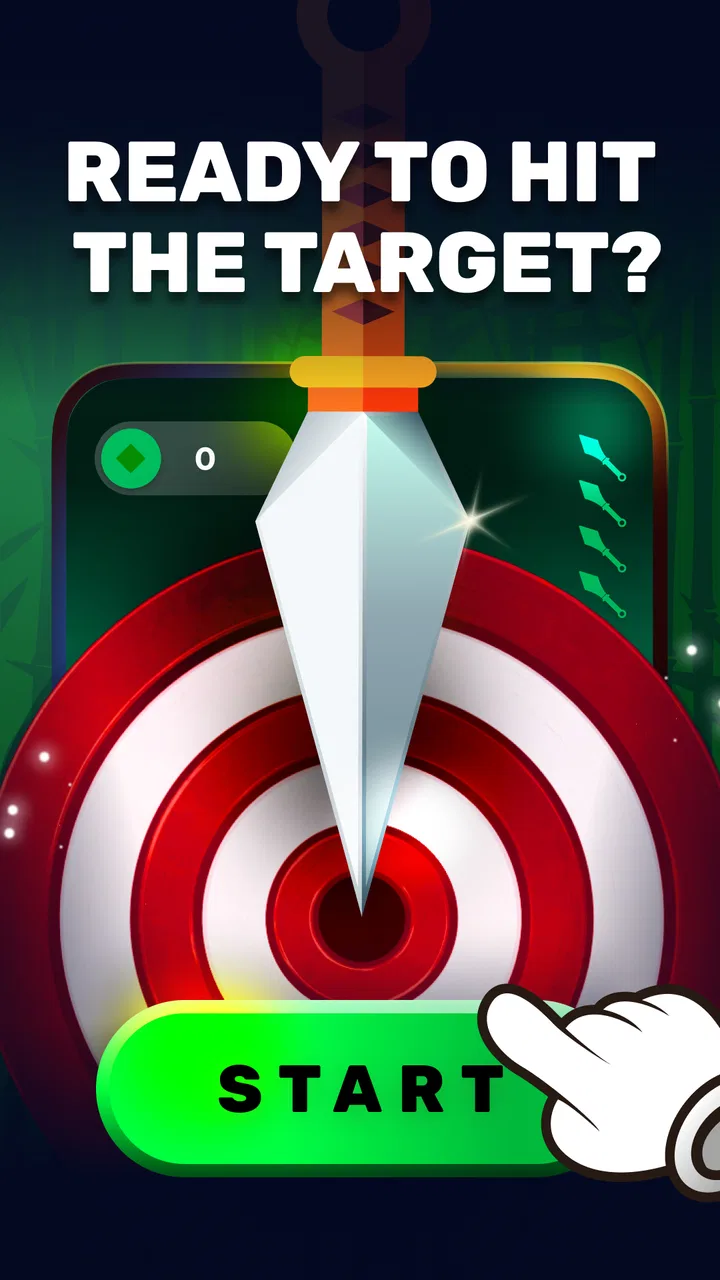
Knife Hit Master: Arcade Game is a casual arcade title built around a simple but challenging mechanic: throwing knives at rotating targets without hitting knives that are already embedded in the surface. Each level tests your timing, precision, and patience. As you progress, targets may rotate faster, change direction, or include obstacles, making later stages considerably more demanding than the opening levels.
02How do you play Knife Hit Master: Arcade Game?
Gameplay is easy to understand, which makes the app suitable for short sessions. Tap the screen to throw a knife toward the rotating target, then wait for a safe opening before tapping again. You must place all available knives without colliding with another knife or obstacle. A mistimed throw usually ends the attempt, so observing the target’s rhythm is more important than tapping quickly.
03Is Knife Hit Master: Arcade Game free to download and play?
Knife Hit Master: Arcade Game can generally be downloaded for free, allowing players to try the core arcade experience without an initial purchase. However, free versions of this type of game may include advertisements, optional rewards, or in-app purchases. Before downloading, check the current store listing for pricing details, advertising information, and any available purchase options, since these can change with updates.
04Does Knife Hit Master: Arcade Game require an internet connection?
The basic knife-throwing gameplay is typically suitable for offline play, which is convenient when you want a quick distraction without mobile data or Wi-Fi. Some features, such as advertisements, leaderboards, cloud synchronization, special events, or rewarded bonuses, may require an internet connection. Availability can vary by version and device, so it is worth testing the game offline after installation.
05Is Knife Hit Master: Arcade Game suitable for children and casual players?
The controls are simple and the game does not require advanced gaming experience, so casual players can learn the mechanics within a few attempts. Its difficulty comes from timing rather than complicated controls. Parents should still review the age rating, advertising, and in-app purchase information on the relevant app store, particularly if children will use the game without supervision.
Pros
- Simple tap controls make it easy for beginners to pick up.
- Short rounds are ideal for quick gaming sessions.
- Increasing difficulty keeps the gameplay challenging over time.
- Offline play lets you enjoy it without a constant internet connection.
- Bright visuals and sound effects make hits feel satisfying.
Cons
- Repeated mechanics may become monotonous after extended play.
- Mistimed taps can quickly end a round and feel frustrating.
- Progression may feel slow without frequent play.
- Ads can interrupt the experience between rounds.
- Small screens may make precise timing more difficult.

Knife Hit Master: Arcade Game
Gallery